



Sourcing steel flanges from China offers unparalleled manufacturing scale, cost-efficiency, and a robust supply chain network. However, for critical engineering projects—ranging from oil and gas extraction to chemical processing, power plants, and marine infrastructure—price is merely one variable in a complex procurement equation.
To secure operational safety and prevent catastrophic piping failures, global procurement managers must look beyond basic quotes. The real criteria for success rest on highly specific technical parameters: complete dimensional accuracy, precise material chemistry, fully audited pressure classifications, and verifiable documentation packages. This comprehensive guide details the essential quality benchmarks and tactical procurement workflows required to source high-performance ASME steel flanges from China with absolute confidence.
1. Start with the Correct Flange Standard
Establishing accurate dimensional standards is the foundation of structural integrity in pressurized piping networks.
ASME B16.5 (NPS 1/2 to NPS 24)
This standard governs smaller to medium-sized pipe flanges and flanged fittings. It covers extensive pressure-temperature ratings, materials, tolerances, marking protocols, and testing systems. It encompasses pressure classes 150, 300, 400, 600, 900, and 1500, with Class 2500 specified up to NPS 12.
ASME B16.47 (NPS 26 to NPS 60)
Designed for large-diameter pipelines, this standard outlines Series A and Series B designs. Series A (originally MSS SP-44) features thicker, heavier profiles designed for high external piping loads, while Series B (originally API 605) utilizes smaller, more numerous bolts for compact, lighter installations. They are not interchangeable.
Pro Buyer Tip: Dimensional and material standards are distinct entities. An RFQ must state both the dimensional envelope (e.g., ASME B16.5) and the exact metallurgical material specification (e.g., ASTM A105N or ASTM A182 F316L) to eliminate any structural ambiguity.
2. Select the Flange Type Based on Piping Design
Different connection configurations are engineered to handle specific thermal, mechanical, and fatigue profiles.
Weld Neck (WN)
Characterized by a tapered hub that matches the pipe’s inner diameter. Best for high-pressure, extreme-temperature, and cyclic-stress conditions. Ensures optimal flow dynamics and minimal turbulence.
Slip On (SO)
Slipped over the pipe and welded both internally and externally. Ideal for low-pressure, low-vibration applications. Offers easier alignment and lower initial manufacturing costs.
Socket Weld (SW)
Designed with a socket bore to receive the pipe end before fillet welding. Primarily utilized for smaller, high-pressure instrument and control piping lines (typically below NPS 2).
Threaded (TH)
Joined via NPT or other standard threads without welding. Critical for hazardous environments where hot-work welding is prohibited, or in systems with highly sensitive internal linings.
Lap Joint (LJ)
Used in conjunction with a stub end. Allows the backing flange to rotate freely for easy bolt alignment. Excellent for systems requiring frequent disassembly and cleaning.
Blind (BL)
Solid steel discs used to seal the ends of piping runs or pressure vessel openings. Subjected to the highest mechanical stress loads due to internal pressure forces.
3. Material Specification: Do Not Order by Grade Name Alone
A generic request for "stainless steel" or "carbon steel" is a major procurement risk. High-performance projects require precise ASTM designations.
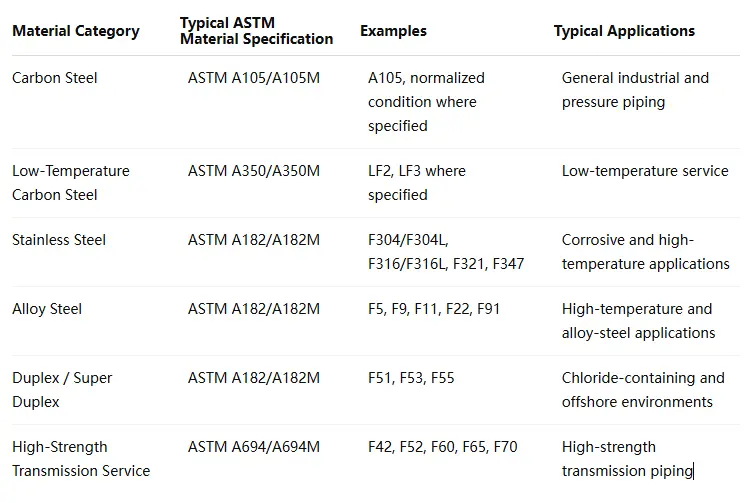
| Material Group | Common ASTM Standard | Grades / Designations | Typical Applications |
|---|---|---|---|
| Carbon Steel | ASTM A105 / A105N | Standard Carbon Forging | Ambient and high-temperature systems, general process piping |
| Low-Temp Carbon Steel | ASTM A350 | LF2, LF3, LF6 | Sub-zero temperature environments, arctic or deep-sea pipelines |
| Alloy Steel | ASTM A182 (Alloy) | F5, F9, F11, F22, F91 | High-temperature, high-pressure power generation, steam lines |
| Stainless Steel | ASTM A182 (Stainless) | F304/304L, F316/316L, F321, F347 | Corrosive chemical processing, food, pharma, and marine environments |
| Duplex / Super Duplex | ASTM A182 (Duplex) | F51, F53, F55, F60 | Highly aggressive chloride environments, desalination, offshore oil & gas |
4. Pressure Class and Flange Facing Specifications
Pressure ratings and gasket contact surfaces must be explicitly paired to guarantee a leak-proof seal under loaded operations.
Pressure Ratings
Standardized classes include Class 150, 300, 400, 600, 900, 1500, and 2500. Actual pressure boundaries vary dynamically based on the design temperature and material grade of the flange.
Raised Face (RF)
The most common configuration. Concentrates gasket pressure on a raised 2mm (for Class 150/300) or 7mm (Class 600+) profile, maximizing joint efficiency.
Ring Type Joint (RTJ)
Features deep, machined grooves that house metallic ring gaskets. Engineered for high-pressure, high-temperature service exceeding 10,000 PSI.
Surface Finish Note: Specify the exact spiral or concentric serration requirements (typically 125–250 AARH or Ra 3.2–6.3 µm) on the RF surface. Do not assume the factory will default to the correct roughness for your gasket type.
5. Traceability: From Billet to Finished Product
Traceability is the cornerstone of quality assurance. A reliable manufacturer must establish an unbroken chain of documentation.
Every single flange must be traceable back to its original steel melt. When auditing a Chinese manufacturer's traceability system, check for the following data flow:
Melt Heat Number
The original ladle chemistry record from the steel mill.
Forging Log
Details the heating temperature and compression ratio during forming.
Heat Treatment Run
Time and temperature charts proving mechanical properties are fully developed.
6. Heat Treatment Protocols
Heat treatment is a critical metallurgical step required to relieve internal forging stresses and uniform steel grain structure.
Normalizing & Annealing
Carbon steels (like ASTM A105N) are heated above their transformation range and air-cooled (normalized) or furnace-cooled (annealed). This refines the grain size, increases ductility, and enhances low-temperature impact properties.
Solution Annealing
Stainless and Duplex steels are heated to elevated temperatures (e.g., above 1040°C) to dissolve chromium carbides back into solid solution, followed by rapid water quenching. This is critical to prevent intergranular corrosion.
7. Testing and Non-Destructive Testing (NDT)
Quality cannot be assumed; it must be verified. A robust Inspection and Test Plan (ITP) must be established before production.
Mechanical Testing
- Tensile and Yield Strength
- Elongation percentage
- Charpy V-Notch Impact (for low temp)
- Brinell/Rockwell Hardness
Chemical Verification
- Ladle analysis at steel mill
- Product check analysis
- Positive Material Identification (PMI) on finished parts
Non-Destructive Testing
- Ultrasonic (UT) for internal voids
- Magnetic Particle (MT) for surface cracks
- Liquid Penetrant (PT) for stainless surfaces
8. EN 10204 Type 3.1 & 3.2 Certificates
Understanding certification standards is essential to guarantee that test results are authentic and legally binding.
EN 10204 Type 3.1
Issued by the manufacturer's authorized inspection representative, independent of the manufacturing department. It contains the actual test results from the specific production lot (heat number) of the shipped flanges.
EN 10204 Type 3.2
Requires validation of test results by both the manufacturer's authorized representative and an independent, authorized third-party inspector (e.g., SGS, BV, TÜV). Mandatory for highly regulated, high-risk offshore and nuclear installations.
9. Third-Party Inspection (TPI) Framework
Deploying third-party inspectors to the factory floor ensures complete alignment between project specifications and final production.
To avoid post-shipment disputes, integrate a clear Inspection and Test Plan (ITP) into the purchase contract. The TPI agency (SGS, BV, Lloyd’s, DNV, or TÜV) should operate under defined witness levels:
- Hold Point (H): Production cannot proceed past this point without the inspector's physical presence (e.g., raw material verification, mechanical testing, final dimensional check).
- Witness Point (W): The inspector is notified of an activity (e.g., heat treatment, NDT testing). Production continues if the inspector is not present at the scheduled time.
- Review Point (R): The inspector reviews quality records, certifications, and test reports after completion of the process.
10. Critical Dimensional Inspection Checkpoints
Even a minor dimensional deviation can lead to installation failure, misaligned bolt holes, or poor gasket sealing.
The Mating Zone
- Bolt Circle Diameter (BCD): Ensures bolts align with the mating flange.
- Bolt Hole Diameter & Spacing: Prevents bolt binding.
- Raised Face Outer Diameter & Height: Establishes correct gasket contact area.
The Connection Zone
- Flange Thickness: Must meet minimum ASME limits to prevent bending.
- Bore Diameter: Must match the pipe's internal schedule to prevent flow restriction.
- Weld Neck Bevel Angle: Crucial for high-quality field welding.
11. Packaging and Ocean Shipping Protection
Protecting the precision-machined sealing surfaces of flanges during transit is critical to preventing damage.
Corrosion Protection
Carbon and alloy steel flanges must be coated with high-quality rust-preventive oil or temporary lacquer. Stainless steel flanges must be kept free of carbon contamination.
Physical Protection
Machined faces (RF, RTJ) must be covered with plastic or wooden protectors. Flanges should be separated by cardboard layers to prevent steel-on-steel impact.
Export Packaging
Heavy-duty wooden crates or pallets must be used. Solid wood packaging must comply with ISPM 15 heat treatment and fumigation requirements for international customs.
12. How to Evaluate Chinese Flange Suppliers
A lower unit price does not necessarily mean a lower total cost. Evaluate potential partners across five pillars.
1. Technical Capability
Does the mill have the forging press capacity (e.g., 2000T to 8000T presses) and heat-treatment furnaces to handle your specific sizes and material grades?
2. QA/QC Systems
Are they certified to ISO 9001, PED 2014/68/EU, and API? Do they have an in-house laboratory for mechanical testing, chemical analysis, and NDT?
3. Raw Material Sourcing
Do they source raw steel billets from reputable, audited steel mills? Can they provide original mill test certificates (MTC) for the raw materials?
4. Export Track Record
Do they have experience supplying flanges for international EPC projects? Are they familiar with shipping logistics, packing standards, and customs documentation?
5. Customer Service
Is their engineering team responsive? Can they quickly clarify technical deviations, generate CAD drawings, and provide detailed Inspection and Test Plans?
13. What to Include in a Professional Flange RFQ
A complete, detailed RFQ prevents technical misunderstandings and ensures you receive accurate quotes on the first attempt.
Product & Technical Data
- Flange Type: WN, SO, SW, TH, LJ, BL, etc.
- Standard: ASME B16.5, ASME B16.47 Series A/B, etc.
- Nominal Size & Pressure Class: e.g., 8" Class 600
- Material Grade: ASTM A105N, A182 F316L, etc.
- Facing & Finish: RF (125-250 AARH), RTJ, etc.
- Bore/Wall Thickness: Schedule 40, Schedule 80, etc.
Quality & Commercial Data
- Testing Requirements: UT, MT, PMI, Impact testing, etc.
- Certification: EN 10204 Type 3.1 or 3.2
- Third-Party Inspection: Scope and agency (if required)
- Incoterms & Port: e.g., FOB Shanghai, CIF Rotterdam
- Target Delivery Date: Required lead-time
- Packaging: Sea-worthy, ISPM 15 wooden boxes
Frequently Asked Questions
Answers to common technical and commercial questions about sourcing ASME flanges.
Final Checklist for Buyers
Verify these ten items before authorizing production on any Chinese flange order.
- Standard: Verified ASME B16.5 or B16.47 (with correct Series A/B).
- Type: Confirmed exact configuration (WN, SO, SW, BL, etc.).
- Pressure Class: Correct class specified (Class 150 to 2500).
- Facing: Facing type (RF, FF, RTJ) and surface finish (Ra/AARH) defined.
- Material: Explicit ASTM standard and grade (e.g., A182 F316L).
- Heat Treatment: Correct delivery condition specified (Normalized, Solution Annealed).
- Traceability: Unbroken heat-number tracking from steel mill to finished flange.
- Inspection Plan: ITP, NDT methods, and PMI requirements agreed.
- Certification: EN 10204 3.1 or 3.2 certificate requirements defined.
- Packaging: Seaworthy packing, face protectors, and ISPM 15 compliance.
Sourcing ASME Steel Flanges from China with Baishuo Pipeline
Your Trusted Partner for Engineering-Grade Piping Components
At Baishuo Pipeline, we specialize in supplying high-performance industrial piping components to international engineering, procurement, and construction (EPC) companies. Our comprehensive flange portfolio includes Weld Neck, Slip On, Socket Weld, Threaded, Lap Joint, and Blind Flanges, manufactured to strict ASME, ASTM, MSS, API, and EN/DIN standards.
We understand that critical projects require absolute compliance. Our team reviews your bill of materials (MTO), detailed engineering drawings, and specific quality plans before offering a quotation. We provide full material traceability, EN 10204 3.1/3.2 certification, and welcome third-party inspections (SGS, BV, TÜV, DNV) to ensure your peace of mind.
Ready to secure high-quality flanges for your next project?
Send us your detailed flange specifications, quantities, and delivery requirements for a comprehensive, technical quotation.
Contact Our Engineering Team